
A solid brick or block wall keeps noise out well. The door in it usually does not. Most internal doors in UK homes are hollow-core — two thin skins over a cardboard honeycomb — and every door has gaps around all four sides of its frame. Sound behaves like a draught: it pours through the smallest opening, and a gap of a few millimetres under a door can let through as much noise as the rest of the door combined.
The good news: soundproofing a door is mostly about sealing gaps, not rebuilding walls. Work through the methods below in order — cheapest first — and stop when the noise drops to a level you can live with.
First, find the leaks: the torch test
Before buying anything, find out where the sound gets through. Wait until dark, have someone stand the other side of the closed door with a torch or phone light and move it slowly around the edges, while you watch from your side with the lights off. Anywhere light shows through, sound gets through too — they use the same gaps.
Check all four edges, especially the gap under the door — usually the biggest offender, particularly over hard floors. Check the letterbox and keyhole too, and whether the door pulls tight when it latches. A door that rattles or does not close flush leaks sound whatever you stick on it, so if yours does not shut properly, fix the sticking door first before buying seals.
Method 1: Seal the gaps around the frame
The cheapest fix, and usually the biggest difference per pound. Run a seal around the inside of the frame — the stop the door closes against — so it compresses slightly when the door shuts.
- Self-adhesive weatherstrip tape is the simplest option: a few pounds a roll, on in minutes. Rubber or silicone profiles outlast foam, which flattens within a year or two.
- Acoustic door seals are firmer rubber or silicone gaskets made for sound rather than weather — they cost more than foam tape but seal harder and last far longer.
- Acoustic sealant fills hidden gaps between frame and wall and around the architrave. Unlike decorators’ caulk it stays flexible instead of cracking; push foam backer rod into deep gaps first.
Sealing gaps alone can typically cut noise through a doorway by around 10–15 dB — roughly the difference between hearing a conversation word for word and hearing a muffled hum.
Method 2: Seal the gap under the door
The threshold gap lets the door clear the floor, but it is an open slot for sound. Your options, in rising order of cost and effectiveness:
- A draught excluder — the classic fabric sausage — is the zero-effort household option. It only takes the edge off, but costs almost nothing and needs no fitting.
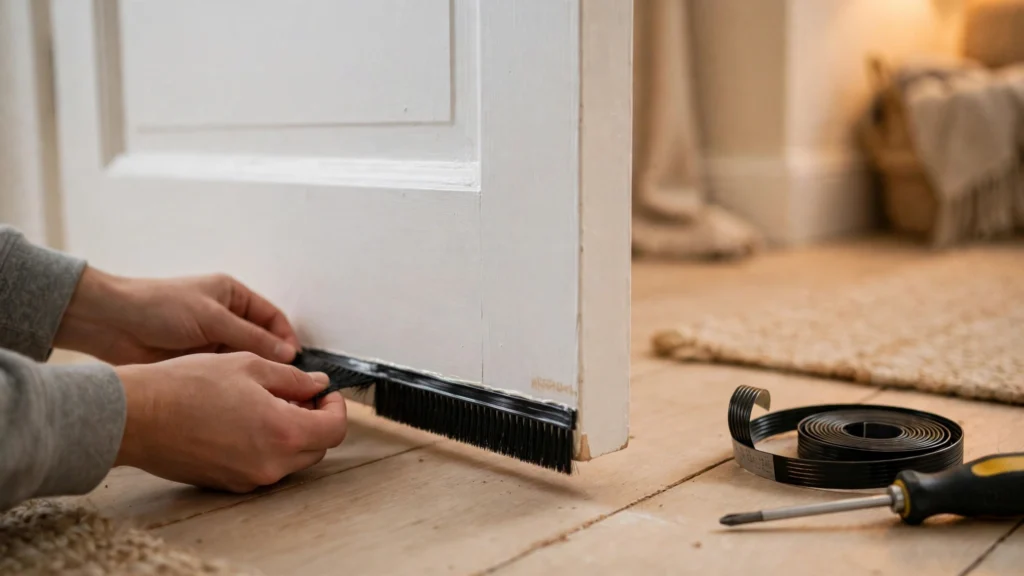
- A brush strip screws to the bottom of the door and drags fine bristles across the floor, coping well with uneven floors.
- A door sweep has a rubber blade pressing against the floor or threshold, and seals more firmly than a brush.
- An automatic drop seal is the proper job: a mechanism in a groove routed into the bottom of the door, dropping a rubber seal as the door closes and lifting it as it opens. It needs a joiner or confident DIYer, but seals like a fixed threshold with nothing to trip over.
Any of these seals better if it meets a raised threshold strip fitted on the floor.
Method 3: Add mass to the door itself
Sealing stops sound leaking around the door. If noise still comes through it — common with hollow-core doors, which sound drum-like when knocked — the answer is mass. Sound struggles to move heavy, dense material.
- A soundproof blanket hung on the room side is the quickest upgrade: hang a heavy, dense blanket from hooks over the door so it covers the whole slab and overlaps the frame slightly. Not pretty, but effective.
- Mass-loaded vinyl (MLV) is a thin, very heavy sheet cut to size and fixed to the door face — serious weight in a few millimetres.
- An extra layer of MDF or plywood, screwed and glued to the door face, is the budget version. It changes the door’s look and adds weight, so check the hinges can cope. A door that drops on strained hinges undoes all your gap sealing.
Method 4: Household items and renter-friendly fixes
Renting, or working on a door you cannot modify? You can still make a real difference with things that leave no mark:
- Hang a heavy curtain over the doorway on a portière rail or tension rod. A thick, lined curtain — velvet or heavy blackout fabric works well — is dense material sound must pass through; even a floor-length curtain on a simple wire dulls noise noticeably.
- Use a draught excluder at the base of the door, as above — nothing to fit or remove.
- Soften the room itself. A thick rug and soft furnishings near the door absorb sound that gets in, so the room feels quieter.
- Seal the letterbox and keyhole. A letterbox is a hole in the door with a thin flap: a brush-style letterbox draught excluder or internal cover helps a lot on a front door, and a keyhole cover plate stops noise through an old keyhole.
Combined, these can turn “I can hear every word” into a background murmur — often enough for a rented flat.
Method 5: Replace a hollow-core door with a solid-core door
If you have sealed everything and the door itself is still the problem, replacing it is the biggest single upgrade available. A hollow-core door typically costs around £30–£60; a solid-core door is more like £100–£300 — heavier, denser, far harder for sound to pass through. Solid-core fire doors (rated FD30) are a popular choice: the core that resists fire also resists sound, and they come in standard UK sizes.
It helps to know what you are replacing: our guide to flush doors and panel doors covers the main types. Budget for fitting on top if not hanging it yourself — a solid door is heavy and usually needs trimming. Keep your seals from methods one and two: a solid door in a leaky frame still leaks.
If the door is part of a bigger job, tackle it while the surrounding work happens, as part of the wider plan in our house renovation guide.
Soundproofing methods compared
| Method | What it fixes | Rough cost | Effort |
|---|---|---|---|
| Weatherstrip / acoustic seals | Gaps around edges | Under £20 | Low — under an hour |
| Acoustic sealant | Hidden frame gaps | Under £15 | Low |
| Draught excluder | Gap under door (partial) | Under £10 | None |
| Brush strip or door sweep | Gap under door | £10–£30 | Low — basic DIY |
| Automatic drop seal | Gap under door (best seal) | £30–£80 plus fitting | Medium — routing needed |
| Soundproof blanket | Sound through thin door | £40–£100 | Low — hangs on hooks |
| Mass-loaded vinyl or MDF layer | Sound through thin door | £50–£150 | Medium |
| Heavy curtain over doorway | Through-door noise, renters | £30–£100 | Low |
| Solid-core door | The door itself | £100–£300 plus fitting | High — or pay a joiner |
A full DIY job typically totals £100–£500.
What does not work: egg boxes and foam panels
The most persistent myth in DIY soundproofing is that egg boxes or acoustic foam panels stuck on a door will block noise. They will not. Foam and egg boxes absorb sound inside a room — they calm echo. Blocking sound passing through a door needs the two things foam lacks: an airtight seal and heavy, dense mass. A foam-covered door with an open gap underneath still lets the conversation next door straight in — through the gap. Seal first, add mass second — anything light and spongy is decoration.
Frequently asked questions
Can you soundproof a door without replacing it?
Yes — in most cases you do not need to. Seal the gaps around the frame and under the door, then add mass with a blanket or MLV if the door is hollow-core, and most doors reach an acceptable level. Replacement is only the last step.
What is the cheapest way to soundproof a door?
Sealing. Weatherstrip tape, acoustic sealant and a brush strip or sweep together cost well under £50, and sealing typically makes the single biggest difference — often around 10–15 dB. Start there before spending on the door itself.
Does a draught excluder help with noise?
A little, yes. It blocks part of the gap under the door — a major route for sound — so it takes the edge off. But it only rests against the door rather than sealing to it, so a fitted brush strip or sweep does better. As a no-fixings option for renters, still worth doing.
Is soundproofing a door worth it for a home office or bedroom?
Usually, yes — these are the rooms where door noise matters most, and treatment is cheap on internal doors. For a home office, sealing plus a door sweep often makes calls private; for a bedroom off a noisy landing, a blanket or solid-core door is worthwhile if sleep suffers.



More Stories
How to Fix a Sticking Door: A Complete UK Guide
Garage Door Won’t Open? Common Causes and How to Fix Them
Where to Source Authentic Timber for a Colorado Ski Home